Happy 697th to the Ming Founder!

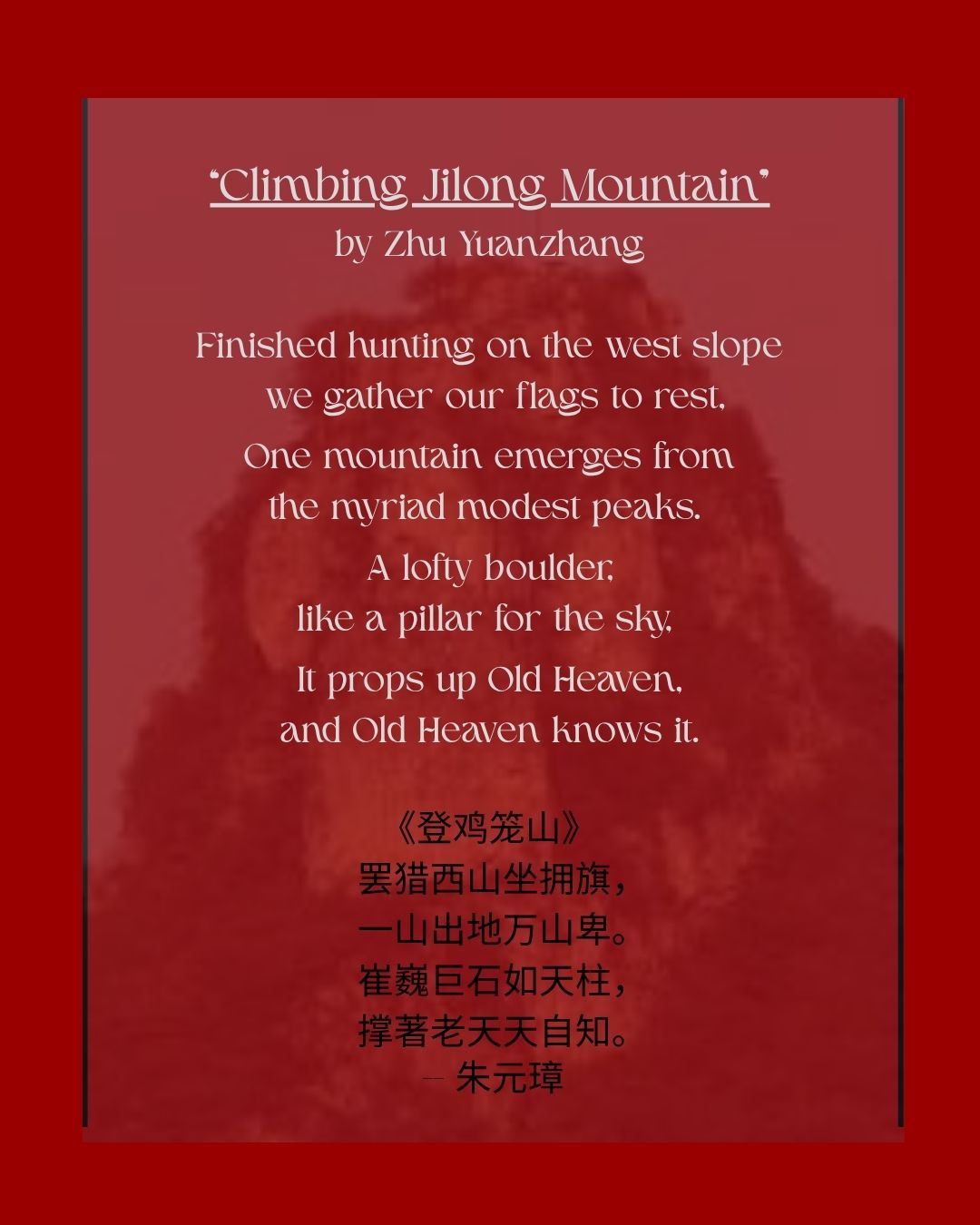
Poem in English and Chinese, "Climbing Jilong Mountain"

October 21, 2025, marks the 697th birthday of Zhu Yuanzhang, founder of China’s Ming Dynasty. He was born (on what corresponds to Oct. 21 on our modern calendar) in 1328, founded the Ming Dynasty in 1368, and died in 1398. Those lucky eights seem auspicious except that they are based on the Western Gregorian calendar and would have meant nothing to Zhu Yuanzhang himself. In the context of his era, he was born in an Earth Dragon year on the 18th day of the 9th month of the 1st year of the Tianli 天曆 reign of the Mongol Yuan Dynasty’s Wenzong 元文宗 Emperor Tugh Temur.

However you cite it, we are a mere three years from the big 700!

To mark this day, here’s a poem that is attributed to Zhu Yuanzhang. Written in 1355, it’s titled “Climbing Jilong Mountain” and describes the view of a summit near today’s Hexian, Anhui Province, located along the northern banks of the Yangtze River:

Continue reading

The anthem of the Red Turban Rebellion

It’s an incendiary lyric with no title by an anonymous author. I consider it the anthem of the Red Turban rebellion because it describes, in catchy rhyming phrases, the political and economic breakdown that toppled the Mongols in 14th-century China.

This was the same rebellion that Zhu Yuanzhang joined and eventually led, fighting his way from Anhui Province south across the Yangtze River to the city known today as Nanjing, where he established the dynasty that replaced the Mongol Yuan: the Great Ming.

According to the scholar Tao Zongyi 陶宗仪, who lived through this era, the song was soon on everyone’s lips.  He included the words in his vast collection of anecdotes, noting “I don’t know who created this lyric to the Zui Tai Ping tune, but from the capital to Jiangnan, everyone can recite it.” (《醉太平》小令一阕,不知谁所造。自京师以至江南,人人能道之。)

Continue reading

My short story on a 14th-century uprising

Spittoon Collective, an arts group based in Beijing, is featuring my short story, “Stirring the Yellow River,” this month on their website. Of course, I wish I could actually go to Beijing and hang out with book people, but having a group like this offer my story, along with an illustration, a Q&A, and even a commentary, is the closest I can get to a writer’s dream come true in the COVID lockdown era. I’m so grateful!

(Illustration by Kerry Dennis)

“Stirring the Yellow River” is my fictionalized version of the 1351 uprising that launched the Red Turban rebellion, which eventually led to the downfall of Mongol rule over China. It’s a bizarre tale that involves a one-eyed stone man, laborers dredging the Yellow River, and an apocalyptic rhyme brought to life.

This story is also a selection from the start of Book 2 (which I am calling “Red Turban”) in my series of fiction about the Ming founding. I have finished the manuscript for this one, but I’m still tinkering and editing…

Continue reading

The cringey world of book promotion

I did not realize, in my dreams about getting a book published, that promotion would be such a big part of the process. Then I started attending conferences for writers and learning about the need to pitch to agents and “have a platform.” With my first book finally out, I felt overwhelmed with all the social media I was supposed to be using to talk about my book. Who has time for all that? I asked a friend in the business which social media platform is best. “All of them,” she replied. I vowed I would not pester my friends and family on Facebook. And yet I did. And here I am, talking about my book on Twitter, Instagram, LinkedIn, this website. I’ve made cringey Tiktoks. I’ve tried to make a podcast and learned that it’s hard to sound off-the-cuff interesting, especially when you can’t resist reading from a script. “Don’t read from a script,” my kids told me. But I’m all about scripts – I’m a writer!

Continue reading

Crossing the river

Though I’m not into numerology, it did give me pause to realize that one of the key moments in the founding of the Ming Dynasty occurred exactly 666 years ago.

On the second day in the sixth month of an Yiwei year that corresponds to the Western date of July 10, 1355, Zhu Yuanzhang led his newly-acquired fleet from Hezhou, his temporary base on the northwest bank of the Yangzi River. He was headed toward a outcrop on the far shore known as Ox Barrier. One of Zhu’s newest recruits, Chang Yuchun, was the first to make landfall. Chang jumped to the shore, wielded his ax and rushed toward the Mongol troops. Zhu Yuanzhang’s Red Turbans surged behind Chang’s charge and routed the imperial army from their fort in the cliffs. Chang’s attack was so heroic that it is said you can still see his footprint in the boulders above the site of the landfall.

Such are the tall tales told of that fateful moment.

Continue reading

A herd boy story for an Ox Year

The Lunar New Year for 2021 starts Friday, Feb. 12. Up next in the cycle of the Chinese zodiac animals is the ox.

Since I have been writing fiction about the life story of Zhu Yuanzhang, founder of the Ming Dynasty, an ox year brought to mind stories of how the founder started out as a cattle herder.

Collections of stories about Zhu Yuanzhang’s childhood often include a subversive one from his herd boy days. It comes in a few different forms, but always has the future emperor leading his fellow herd boys in eating one of the animals they are supposed to be protecting.

Continue reading

Why write Ming fiction?

“What’s a nice Jewish girl like you doing writing about the Ming founding?”

1944 book on Zhu Yuanzhang, “From Monk’s Bowl to Imperial Power.”

A California-based literary agent once asked me this after I proposed a novel about the story of the fourteenth-century Ming Dynasty founder, Zhu Yuanzhang.

How to reply?

I mentioned that I’m not actually Jewish, but I knew that was not the point of the question. The agent was trying to tell me that he thought it strange to hear the idea for such a book coming from someone who is not Chinese.

Continue reading

My son, my book cover artist

Structuring a novel is a murky process, but one moment stands out in my mind as key to both my novel, The Lacquered Talisman, and its cover, which was created by my son.

I was sitting on the floor of a bookstore in Boston, flipping through art books about China, when suddenly it hit me: What I needed for my main character was a talisman. And this talisman would be a seal chop. The Lacquered Talisman is about the Zhu family, whose youngest son founded the Ming Dynasty in 1368. I needed a tangible item that could symbolize family for my protagonist. Thus the talisman. Continue reading

Five-star review of THE LACQUERED TALISMAN

Here’s a five-star review of my debut novel published August 12, 2020 on IndieReader.com, a website devoted to hybrid, small press, and self-published authors:

THE LACQUERED TALISMAN leads readers from the marriage of the first Ming Emperor’s parents, through his young life, and his years of devotion as a Buddhist monk, to the beginnings of the rebellion that would overturn a dynasty and set him on the throne of one of the greatest empires the world has ever known.

Source: THE LACQUERED TALISMAN

My profile with IndieReader.com discusses why I decided to write a novel about the founder of the Ming Dynasty, who I’d pick to play him in a movie, and more. Happy reading!